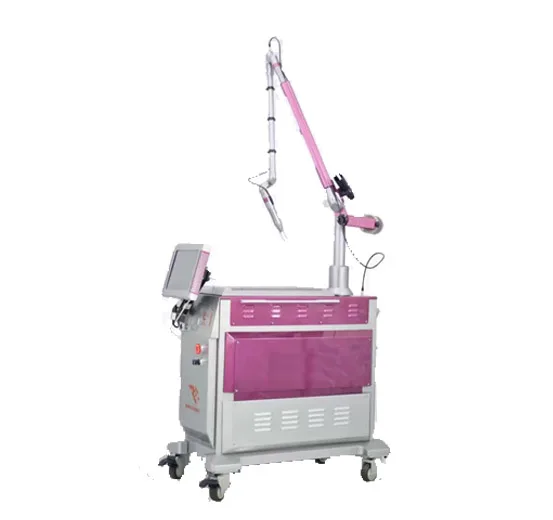
Q-switched Nd:YAG
A dual-wavelength family documented for professional pigment and tattoo workflows.
- Energy source
- 1064 + 532nm
- Quotation status
- 1064nm / 532nm
Platform overview
Place the platform in the right comparison set.
The archived Q-switched Nd:YAG material documents 1064nm and 532nm outputs. Use the exact model sheet to compare wavelength delivery, spot-size options, pulse characteristics and cooling.
Buyer goals
Where this family belongs.
- Pigment-focused treatment menu
- Tattoo-work equipment comparison
- Dual-wavelength laser portfolio
Quote checklist
What to verify model by model.
- 01Wavelength delivery
- 02Pulse characteristics
- 03Spot-size options
- 04Cooling and beam delivery
Buyer guide
Begin with target colour and depth
Q-switched Nd:YAG equipment belongs in pigment and tattoo comparisons because it delivers short pulses at defined wavelengths. This family is commonly compared through 1064nm and frequency-doubled 532nm outputs. Those numbers are not two interchangeable labels. They guide how a trained professional thinks about absorption, target colour, depth and the pigment present in surrounding skin.
A buyer should separate tattoo work from general pigment work before asking for price. Tattoo inks vary in composition and colour, while pigmented lesions require proper identification before any energy treatment is considered. A machine cannot diagnose a lesion. The workflow must include consultation, referral boundaries, photography, eye protection and aftercare.
Buyer guide
Short pulses do not remove the need for control
The practical system includes more than a wavelength badge. Compare pulse characteristics, spot-size options, beam delivery, aiming, cooling, footswitch behaviour and the way the interface records or displays settings. Ask the supplier to demonstrate how the operator changes wavelength and how the corresponding handpiece or optic is identified. A mix-up here is an operational risk.
Beam quality and delivery consistency are difficult to judge from a product photograph. Request an unedited demonstration and ask how the optical path is cleaned, checked and serviced. Find out which components are user-maintained and which require a technician. Put included optics and protective eyewear on the quotation instead of assuming that every image shows the standard package.
Buyer guide
Build a consultation-led business case
Published clinical literature describes Q-switched 1064nm and 532nm systems across tattoo-removal work, but response varies with ink colour, density, layering, location and prior treatment. Multiple sessions may be involved, and complete clearance cannot be guaranteed. If your commercial plan depends on one uniform result, revise the plan before you buy.
For pigment work, diagnostic boundaries are even more important. Do not turn a catalogue indication into permission to treat an unknown lesion. The site deliberately avoids protocols and guaranteed results. Your local clinical governance, current device instructions and professional training determine what can be offered.
Buyer guide
Verify the exact optical package
A useful quote identifies the model, delivered wavelengths, switching method, pulse and spot ranges, cooling, beam-delivery parts, eyewear, electrical version, training and service terms. Ask which consumable or wear parts are expected and how replacements are obtained. If the platform is sold with optional functions, require a line-by-line list of what your price includes.
General technical references explain the operating concepts, but they are not a current certificate set. Ask for destination-market documentation tied to the offered model, then check dates, scope and holder identity. That verification belongs in procurement, not after shipment.
Limits and safeguards
Know what the platform cannot decide for you.
- Pigmented lesions require competent identification; equipment is not a diagnostic tool.
- Tattoo response varies with ink, colour, depth, location and treatment history.
- Complete clearance and a fixed number of sessions should not be promised.
- Wavelength-specific optics, eyewear and training must match the delivered model.
Related decisions
Continue through the treatment map.
- Pigment & Tattoo — Use target depth and colour to compare Q-switched laser with configurable light platforms.
- Multi-treatment Menu — Compare configurable light, RF and selected laser families around the services you intend to offer.
Frequently asked questions
FAQWhy are 1064nm and 532nm shown together?
Many Q-switched Nd:YAG families provide the fundamental 1064nm output and a frequency-doubled 532nm output. They have different absorption behaviour and are selected according to the target and clinical judgment, not as interchangeable modes.
Can the machine identify which pigment should be treated?
No. Diagnosis and suitability are professional decisions. Suspicious or uncertain lesions require referral and must not be treated simply because a catalogue lists a pigment application.
What should a product demonstration include?
Ask to see wavelength changeover, optic identification, aiming, spot adjustment, cooling, eyewear, startup and shutdown. Also ask how the optical path is maintained and how service handles alignment or energy-delivery concerns.
Evidence trail
Published research used in this guide
These papers support the technology context. They do not replace the current manual, training or documentation for the exact equipment named in a quotation.
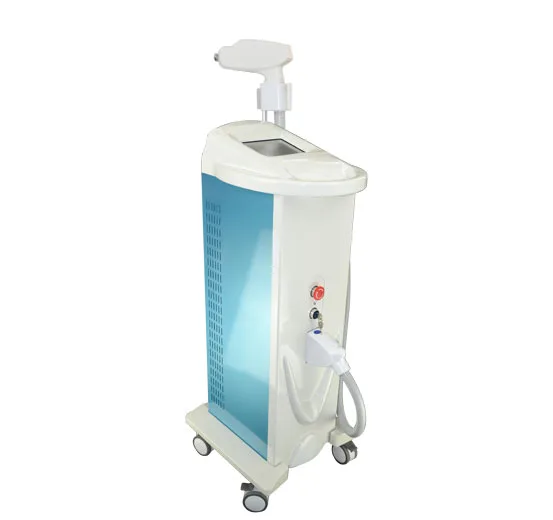
808nm Diode Laser
A single-wavelength platform documented for professional hair-reduction workflows.
808nm↘02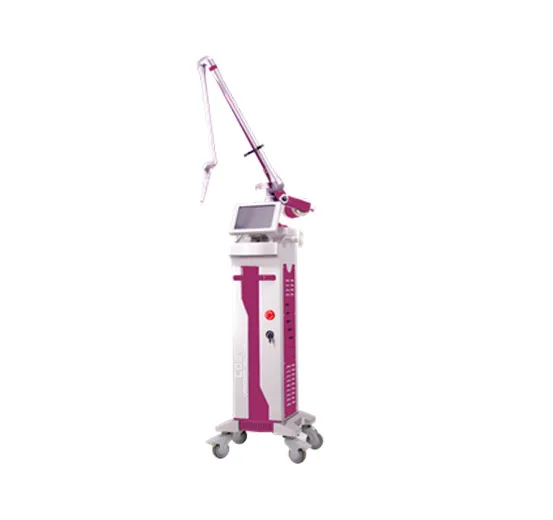
Fractional CO₂ Laser
A 10600nm fractional family with configurations for different professional workflows.
10600nm↘04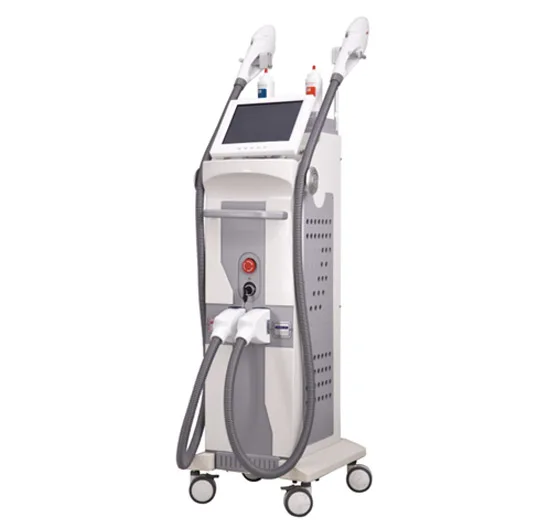
OPT & IPL Platform
Configurable light-based platforms for buyers building a broader treatment menu.
Broad-spectrum light↘Next step
Discuss the right Q-switched Nd:YAG configuration.
Tell us your priority services, market, client mix and business type. Ask for the exact configuration, documents, training and service terms you need.
Describe your equipment plan ↘