Business
Three-Year Cost of Owning a Cavitation Platform
Two quotations land on your desk and the cheaper one usually wins the meeting. A cavitation machine cost of ownership model asks a harder question: what has this console cost you by month thirty-six, and what did a single session cost once you divide? Build the model first, then read the prices.
Buyer guide
The model, before either price
Cost of ownership is defined as the purchase price plus every cost the console causes over a fixed window, divided by the sessions it delivers in that window. Three years is the right window for a body platform. Long enough for a first applicator to wear out, short enough that you can still forecast your diary without inventing it.
Start with volume, because volume drives every line under it. Three clients a day, five days a week, forty-eight working weeks gives 720 sessions a year and 2,160 across three years. Our device manuals put a full body course at 10 to 12 sessions, twice weekly for the first fortnight and weekly after that, so 2,160 sessions is roughly 180 to 216 completed courses. Write that number at the top of the page. Everything below gets divided by it.
Then list the lines, one at a time. Gel. Handpiece and transducer. Electricity. Cleaning and disposables. Training at purchase, and training again later. Spares you keep on your own shelf. Downtime, which almost nobody prices at all.
Buyer guide
Gel adds up faster than anyone expects
Gel per session is the line buyers wave away and finance discovers in year two. No brochure will give it to you. Measure it instead: weigh a full bottle, run a normal working day, weigh what's left, divide by the sessions you ran. One afternoon of arithmetic and you own that number for good.
What sets the volume is contact area and time, not the price of the box. Our engineering archive puts a cavitation ultrasonic tip at 72 mm across, driven at 40 kHz, and one of our slimming manuals caps a single working cycle at 30 minutes. Half an hour of continuous coupling over a 72 mm face consumes real product, and a therapist who lets the layer go thin is coupling sound into air rather than tissue. Formats differ in tip count and duty, so compare them on our ultrasonic cavitation platforms before you model the consumable.
Buying the cheapest drum is not automatically a saving. CDC investigators linked 119 Burkholderia stabilis infections across 10 US states to contaminated nonsterile, multiuse ultrasound gel between May and September 2021, and the implicated products were recalled nationally. One infection control incident costs more than three years of good gel.
Buyer guide
Handpiece life decides the winner
Ask one question, in writing. How many hours or how many sessions is the transducer expected to last, and what does a replacement cost? A supplier who won't put that in writing has already answered you.
Spare parts pricing in our engineering archive shows the shape of the problem. On a laser platform whose parts list we still hold, the treatment handpiece is quoted at close to three times the combined price of the control board, the display board with its screen, a spare screen and the water filter added together, and the handpiece price climbs again at each higher output tier. Boards are cheap. The part a therapist holds all day is not.
Some of that life is your own behaviour. Our device manuals tell operators to clean the handpiece after every treatment and return it to its holder so it can't fall, and the slimming protocol warns that hair longer than 1 cm gets drawn into the roller and suction and damages the handle. A dropped applicator isn't an accident. It's a purchase. Our parts and service guidance sets out which failures a warranty typically declines to cover.
Buyer guide
Electricity is a rounding error, and you should prove it
Run this once so it stops eating meeting time. A portable cavitation platform in our engineering archive is rated at 350 W nominal power. At 2,160 sessions of 20 minutes, you have 720 machine hours across three years. Assume the console pulled its full nameplate rating for every one of those hours, which it will not, and you get 252 kWh. Priced at the 13.54 cents per kWh the US Energy Information Administration reported as the commercial average for May 2026, three years of electricity comes to about 34 dollars.
So stop arguing about power draw and start arguing about filters. The same manuals ask for the air filter to be unscrewed, brushed in pure water and refitted every two to four weeks, which is somewhere between 39 and 78 cleanings over three years of somebody's paid time, and they put a user-replaceable 250 V / 10 A fuse in the power socket. Couch roll, alcohol wipes, gauze, disposable underwear, a proper handle holder. None of it dramatic. All of it per session.
Buyer guide
Training, and then training again
Budget training twice. Once at installation, once on the morning your best therapist hands in her notice. Our device manuals are blunt that every operator must qualify on the training before touching the equipment, and that qualification doesn't pass down the grapevine.
Protocol discipline is where the money actually sits. In a 2022 prospective pilot in Aesthetic Plastic Surgery, Urdiales-Galvez and colleagues treated 15 patients with pulsed ultrasound and unipolar radiofrequency over four sessions one week apart, 15 minutes each; reported adverse events were mild discomfort and mild erythema, all resolving without treatment, with no burns or skin atrophy observed. Small pilot, and the authors say so. The structural point holds anyway. Outcomes in this category come from a scheduled course delivered the same way every time, and an untrained hand delivers neither the schedule nor the sameness.
Screening carries a cost too. The contraindication list in our slimming treatment guidance covers pregnancy, pacemakers and other implanted electronics, epilepsy, kidney stones and metal implant surgery, among others. Judging who is suitable, and recognising the ones who need a diagnosis rather than a course, belongs to a qualified clinician. Put that consultation time into your body programme design and into your cost per session, because it is one.
Buyer guide
Downtime, priced in cancelled appointments
A repair invoice is not the cost of a breakdown. The diary is.
Price it directly: working days out of service, times sessions a day, times your session price. A console dead for ten working days at three sessions a day costs you 30 sessions of revenue, plus whichever clients rebooked elsewhere and stayed there. Set that against the price of keeping a spare transducer, a spare fuse and a spare filter on your own shelf. The shelf usually wins, and it wins by a lot.
Ask for lead times by part class, ask whether a loaner exists, ask where the nearest stock physically sits. A part flown in from another continent turns a two-day fault into a three-week hole in your revenue.
Buyer guide
How a cheaper console finishes three years more expensive
The whole trick fits in one line of arithmetic. Console A costs D less than console B. A only finishes cheaper if D is larger than A's extra running cost per session multiplied by every session you will run in three years. At 2,160 sessions, an extra 2 dollars per session in gel, consumables and applicator amortisation is 4,320 dollars of difference. A discount is paid once. A running cost is paid 2,160 times.
Convert each quotation the same way. Step 1: fix your session volume for 36 months. Step 2: measure the consumable per session and multiply it out. Step 3: get expected handpiece life and replacement price in writing, then divide price by life to get a per-session figure. Step 4: add electricity, filters and disposables. Step 5: add both training events and the spares you intend to stock. Step 6: add expected downtime, valued in sessions lost rather than invoices paid. Step 7: divide the lot, console included, by your session count.
One caution before anyone builds a business case on the output. The FDA states plainly that non-invasive body contouring does not treat obesity, will not produce weight loss, and may give results that are only temporary. Price the machine on sessions you can honestly repeat, not on the transformation in somebody's slide deck.
Frequently asked questions
FAQWhat belongs in a three-year cavitation cost model?
Seven lines, then one division. Purchase price, gel and coupling consumables, handpiece or transducer replacement, electricity, cleaning items and filters, training at purchase plus a second round after staff turnover, and downtime valued in lost sessions. Add spares you hold locally. Divide the total by the sessions you realistically expect to deliver in 36 months, and you have a per-session figure that survives comparison between two quotations.
How do I estimate gel consumption without guessing?
Weigh it. Take a full bottle, run a normal working day, weigh the remainder, then divide the difference by the number of sessions you ran. Repeat on a busy day and a quiet one. Contact area and treatment time drive the number, and our archive puts a cavitation tip at 72 mm across with a working cycle capped at 30 minutes, so a long abdominal session uses noticeably more than a short one.
Is electricity worth putting in the model at all?
Include it once, then stop discussing it. A 350 W platform running 720 machine hours over three years draws at most 252 kWh, and at the 13.54 cents per kWh US commercial average reported by the EIA for May 2026 that is roughly 34 dollars in total. Useful only as proof of where the real money isn't. Gel, applicators and downtime are where the model actually moves.
How much downtime should I assume?
Nobody can hand you a number honestly, so build the model around lead time instead. Ask your supplier which parts ship same week, which ship in a month, and where the nearest stock sits. Then multiply the worst realistic outage by your daily session count and your session price. That figure tells you how much a locally held spare transducer or filter is worth paying for in advance.
Evidence trail
Published research behind this guide
This guide is educational material for equipment selection. It is not medical advice, an operating protocol or a promise of clinical outcome.
Read the research
- US Energy Information Administration, Electric Power Monthly, Table 5.6.A, Average Price of Electricity to Ultimate Customers by End-Use Sector, May 2026 and 2025: the US commercial sector average retail price of electricity was 13.54 cents per kilowatthour in May 2026. ↗
- Hudson MJ, et al. Outbreak of Burkholderia stabilis Infections Associated with Contaminated Nonsterile, Multiuse Ultrasound Gel, 10 States, May to September 2021. MMWR Morb Mortal Wkly Rep 2022;71(48):1517-1521: 119 cases across 10 states from isolates collected 15 May to 14 September 2021, traced to a nonsterile multiuse ultrasound gel; FDA advised discontinuation and discarding of all ultrasound gels and lotions from the manufacturer on 18 August 2021, and the report recommends single-use sterile gel packets ahead of percutaneous procedures. ↗
- Urdiales-Galvez F, Martin-Sanchez S, Maiz-Jimenez M, Viruel-Ortega A. Body Contouring Using a Combination of Pulsed Ultrasound and Unipolar Radio Frequency: A Prospective Pilot Study. Aesthetic Plastic Surgery, 2022: 15 patients completed four sessions one week apart at 15 minutes per session; adverse events were mild discomfort and mild erythema, all resolved without treatment, with no burns or skin atrophy observed. ↗
- US Food and Drug Administration, Non-Invasive Body Contouring Technologies (Aesthetic and Cosmetic Devices): non-invasive body contouring does not treat obesity and will not result in weight loss, and procedures may not always give the desired effect or the result may only be temporary. ↗
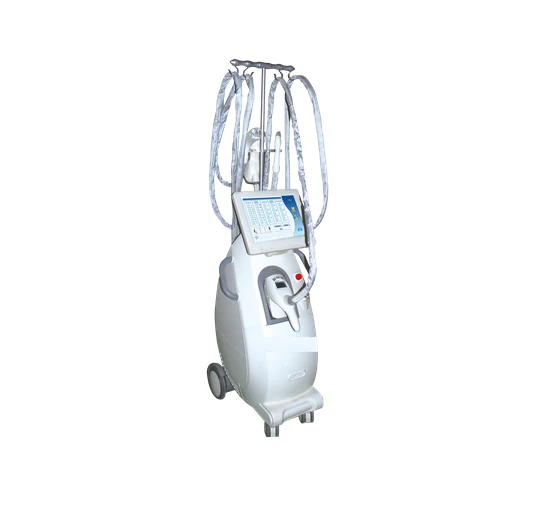
Ultrasonic Cavitation Machines
Cavitation machines buyer guide: how 40kHz ultrasonic cavitation fits a body-contouring menu, what to compare across configurations, and which claims to verify on the exact quotation.
40 kHz ultrasound↘05
RF Skin Tightening
A non-laser energy family for buyers comparing thermal skin platforms.
Radio frequency↘Next step
Compare current configurations against the criteria in this guide.
Tell us your priority services, market, client mix and business type. Ask for the exact configuration, documents, training and service terms you need.
Describe your equipment plan ↘