Technology comparison
Vacuum Butt Lift Machines: What the Suction Really Does
A vacuum butt lift machine is a pump, a set of cups, a pressure regulator and a timer. That is the whole inventory. What you are buying is a service that changes how a buttock looks for a while, and the distance between that sentence and the one in the brochure is where refunds come from.
Buyer guide
The most oversold corner of the body market
Type butt vacuum machine into a search bar and count how many results promise a non-surgical alternative to fat grafting. Most of them. Photographs an hour apart, surgical vocabulary borrowed for a beauty service, a price low enough that a small studio says yes on a Tuesday.
Regulators drew the line the advertising crosses. The FDA describes non-invasive body contouring as non-surgical work that removes no tissue from the body, and states that it "is not intended to treat obesity or to improve your health, and it will not result in weight loss or contribute to the health benefits associated with weight loss." The American Academy of Dermatology notes that with mechanical massage and vacuum suction, the cellulite improved tends to return within one month of stopping treatment.
None of that makes the machine worthless. It makes it a repeat-appointment appearance service with a short half-life. Price it that way.
Buyer guide
What the suction actually does under the cup
Negative pressure refers to a pressure below the surrounding atmosphere. Inside a cup, skin and the subcutaneous layer are drawn up into the dome. Fascial planes stretch. Fluid moves. Blood flow in the treated patch rises while the cup sits there, and tissue comes away plumped, warm and slightly swollen. Clients like that.
Our engineering archive explains why the effect is visible and fragile at once. The dermis runs roughly 0.5 to 4 mm thick, and its papillary layer carries the capillary loops, the lymphatics and the free nerve endings. Those capillaries measure about 6 to 9 micrometres across, walled by a single layer of endothelial cells. Pull hard enough and you get a bruise, not a lift.
Now the claim that matters. Adcock and colleagues, in the Aesthetic Surgery Journal in 1998, gave vacuum-and-roller treatment to a porcine model in groups of 4, 10 or 20 sessions. They found dense longitudinal collagen bands in the mid and deep subdermal layer, and reported that treatment "did not cause a decrease in subcutaneous tissue thickness," with no fat mobilisation and no fat breakdown products in blood or urine. Suction rearranges tissue. No pump has ever built a gluteus maximus, because muscle grows under load and a cup supplies none.
Buyer guide
The hardware, item by item
Four parts decide whether a vacuum therapy machine for buttocks is a machine or a novelty: the pump, the cups, the regulator that holds a set pressure instead of letting it drift, and the cycling logic that decides whether suction is held or pulsed.
Cycling is the piece buyers skip. Our device manuals for the archive slimming platforms split suction across 8 intensity stages and 4 frequency stages, where frequency stage one is continuous hold with the rollers stopped and higher stages pulse the vacuum on and off. Continuous hold on one spot is what marks skin. Pulsed suction under a moving handpiece is what most protocols want. A console with a single on switch is hold-only hardware.
Regulation is the second tell. The same manuals document a live negative-pressure value on screen, a self-test that measures actual suction and adjusts the pulse rate to match, an interlock that withholds output until vacuum reaches its threshold, a fault message for a leaking gas circuit, and a maximum working time of 30 minutes after which the machine stops itself. Each is a component a cheap builder deletes. On combination consoles the vacuum has a different job, holding tissue against the electrodes so energy reaches the fat layer, which is coupling rather than contouring. Set that beside a purpose-built RF skin tightening platform and the difference in intent shows on the spec sheet.
Buyer guide
How to separate a controlled system from a strong pump
Run this before you pay anything.
- Pressure readout. Ask the negative pressure range in real units, and whether the value is displayed live as you work or merely set at the start.
- Duty cycle. Ask the rated continuous duty cycle of the pump in minutes, because a 45-minute gluteal circuit will heat-soak a pump built for 20-second bursts.
- Cups and consumables. Ask how many cups ship in the box, in which diameters, and what a replacement cup, gasket and filter cost.
- Shared pump. Ask whether the pump is shared with other handpieces, because a shared pump means one modality runs at a time.
- Seal failure. Ask what happens when a seal fails mid-session, and whether the machine tells you or simply gets quieter.
A vacuum head bundled onto a multifunction trolley is not the same product. It was specified for a different shift: small pump, short duty cycle, cup geometry inherited from whatever electrode it served. The same argument as a grid you can carry into the call:
| What you check | Dedicated vacuum system | Vacuum head on a multifunction console |
|---|---|---|
| Pump duty cycle | Rated for a continuous gluteal circuit; ask for the figure in minutes | Specified for seconds-long coupling passes, not a 45-minute session |
| Cup diameter range | Diameters chosen for buttock and thigh contours | Geometry inherited from the electrode it was built to serve |
| Live readout and regulation | Negative pressure on screen; self-test adjusts pulse rate to measured suction | Often a set value only, or a single on switch |
| Interlock and timer | Output withheld until vacuum reaches threshold; timer stops the session | Deleted by a cheap builder; the therapist's wrist is the safety system |
| Cleaning procedure | A published procedure for cups that sit on bare skin | A sentence about wiping the head down |
One question nobody volunteers: how are the cups cleaned between clients, and is there a published procedure or just that line about wiping them down? Hygiene is part of the specification.
Buyer guide
Paperwork, parts and the real cost of ownership
Regulatory status attaches to a claim, not to a box, and it is decided market by market. In the United States, where a massage component has genuinely been cleared, the granted wording is narrow: the 510(k) summary for the PelleFirm and Portrait system, K171262, records the indication as a temporary reduction in the appearance of cellulite. That sentence is the clearance. Not lifting, not reshaping. In the European Union, equipment intended to reduce, remove or destroy adipose tissue sits in Section 4 of Annex XVI to Regulation (EU) 2017/745 with no medical purpose required, and Implementing Regulation (EU) 2022/2347 reclassified that group as class IIb.
So ask, in writing, for regulatory documentation valid in your market, naming the exact model and the indication it covers. Unacceptable answers, all of which get offered: a certificate photo with no model or scope on it, a US clearance waved at a European purchase, a report for a different variant, or the line that a beauty device needs nothing. Your own advertising is what can pull a device into a regulated class.
Then the commercial half, which decides whether the machine earns anything in year two.
- Warranty term and scope. Get the length in writing, broken out: is the pump covered, are cups and tubing excluded as consumables, who pays freight on a return.
- Spare-parts window. Ask for a guaranteed availability period for pump, cups, gaskets, seals and filters. A supplier who will not name one is telling you something.
- Lead time, quoted twice. Once for the machine, once for a spare part after you are open and a cup has split.
- Consumables as a line item. Unit prices and expected replacement cadence, put into your model before you sign.
Cost is not the invoice. It is pump grade and duty rating, cup count and diameter, the replacement cadence of everything that wears, and shipping plus duty into your own country. Our device manuals tell the operator to clean the air filter every 2 to 4 weeks, and the troubleshooting table lists a dirty filter as the first cause of no suction at all. They also want at least 30 cm between the vent hole and the wall, so the room costs you something too.
Buyer guide
The risks are real, and they show on skin
Bruising is the headline risk, and it is less a sign of a bad operator than of physics working. Petechiae, the pinpoint dots left when capillaries rupture, appear quickly at high intensity on thin skin. A treatment parameter sheet in our engineering archive is blunt even at moderate settings: the abdomen and buttock protocol opens at suction intensity 6 with pulse stage 3, and the note says the treated area will be red and that the redness clears in 5 to 7 days. Plan the client's calendar around that.
In deeper phototypes the sequence to worry about is bruise, then inflammation, then post-inflammatory hyperpigmentation sitting in a neat circle exactly where the cup sat. Conservative pressure, a moving cup, a test area first. A butt cupping machine used aggressively on Fitzpatrick V or VI skin can leave a pattern far more visible than anything it improved.
Screening is clinical work and belongs to whoever is qualified under your local rules. The contraindication list our archive manuals attach to vacuum massage includes:
- Cardiac pacemakers or implanted defibrillators
- Pregnancy
- Active infection or damaged skin in the treatment area
- Active herpes lesions
- Malignant lesions
- Severe diabetes
- Uncontrolled hypertension
- Heart disease
- Epilepsy
Add anyone on anticoagulants, anyone with fragile skin, anyone with recent surgery in the area. A new lump, unexplained asymmetry or a lesion nobody has looked at is a referral to a physician, not a booking.
Buyer guide
Write the advertisement so it survives the complaint
The FTC expects health-related advertising claims to rest on competent and reliable scientific evidence, which it defines as tests, analyses, research or studies conducted and evaluated objectively by qualified experts and generally accepted in the profession as yielding accurate and reliable results. For a body-shape claim that usually means randomised controlled human testing. Which sentence in your draft survives that? Delete the rest.
Practical swaps, then. "Lifts and firms the buttocks" becomes a temporary improvement in the appearance and tone of the treated area. "Non-surgical BBL" goes in the bin, because it invites comparison with a volume procedure you are not performing. Permanent, adds volume, builds muscle, inches lost: each is a refund waiting for a date. Say how long the effect lasts and how many sessions maintain it, then put both in the consent form.
Our own position, before you ask for a quotation. Pmise does not sell a dedicated vacuum butt-lift platform, and we will not dress a bundled suction handpiece up as one. If that service is the core of your plan, buy from a manufacturer who specialises in it and who will put a pump duty cycle in writing. Where we can help is the measurable side of a body menu, which is ultrasonic cavitation equipment, and the room, staffing and pricing questions worked through in our body programme planning guide.
Frequently asked questions
FAQDoes a vacuum butt lift machine make the buttocks bigger?
No. Suction lifts and mobilises tissue and raises local circulation, which produces swelling and a fuller look for a period after the session. It deposits nothing. A porcine study published in the Aesthetic Surgery Journal in 1998 gave up to twenty vacuum-roller sessions and found no decrease in subcutaneous tissue thickness and no fat mobilisation at all. Volume comes from fat grafting or implants, both surgical, both a physician's decision.
How long does the visible effect actually last?
Plan for hours to a few days, then a return toward baseline. The American Academy of Dermatology reports that with mechanical massage and vacuum suction, cellulite tends to return within one month of stopping treatment, so maintenance sessions are the model rather than a finished course. Build your price list around a repeating appointment. Clients told this in the consultation renew. Clients who are not, complain.
What regulatory paperwork should I ask the supplier for?
Documentation valid in your own market, naming the exact model and the indication it covers. Requirements differ by country. In the EU, equipment intended to reduce, remove or destroy adipose tissue falls under Section 4 of Annex XVI to Regulation (EU) 2017/745 and was reclassified class IIb by Implementing Regulation (EU) 2022/2347. In the US, cleared massage components carry narrow wording, such as a temporary reduction in the appearance of cellulite. A certificate photo with no model or scope is not an answer.
Can I run this service on the vacuum handpiece already on my multifunction console?
For short passes, often yes. For a paid 45-minute gluteal circuit, usually not. On combination platforms the vacuum exists to hold tissue against an electrode for seconds at a time, so the pump duty cycle and cup range were specified for that job. Ask the supplier for the rated continuous run time and the cup diameters before you list the treatment. A pump that heat-soaks halfway through will end the session for you.
Is bruising normal, or does it mean the operator got it wrong?
Some marking is expected. Dermal capillaries are roughly 6 to 9 micrometres wide with a wall one endothelial cell thick, so they rupture easily under sustained suction. A parameter sheet in our archive notes that at abdomen and buttock settings the treated area goes red and clears in about 5 to 7 days. Extensive bruising, pain outlasting the redness, or marks that darken instead of fading are reasons to stop and seek clinical advice.
Evidence trail
Published research behind this guide
This guide is educational material for equipment selection. It is not medical advice, an operating protocol or a promise of clinical outcome.
Read the research
- FDA, Non-Invasive Body Contouring Technologies ↗
- American Academy of Dermatology, Cellulite Treatments: What Really Works ↗
- Adcock D, Paulsen S, Davis S, Nanney L, Shack RB, Analysis of the Cutaneous and Systemic Effects of Endermologie in the Porcine Model, Aesthetic Surgery Journal 1998;18(6):414-420 ↗
- FDA 510(k) summary K171262, PelleFirm and Portrait system: massage device indicated for temporary reduction in the appearance of cellulite ↗
- MDCG 2023-5, Guidance on qualification and classification of Annex XVI products, December 2023 ↗
- US Federal Trade Commission, Health Products Compliance Guidance (2022) ↗
- Luebberding S, Krueger N, Sadick NS, Cellulite: An Evidence-Based Review, American Journal of Clinical Dermatology 2015;16(4):243-256 ↗
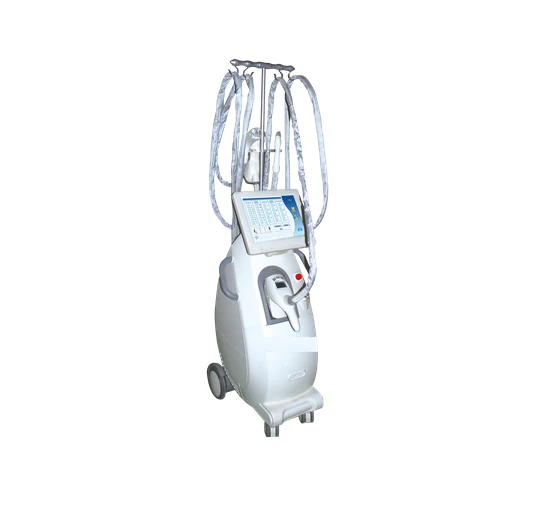
Ultrasonic Cavitation Machines
Cavitation machines buyer guide: how 40kHz ultrasonic cavitation fits a body-contouring menu, what to compare across configurations, and which claims to verify on the exact quotation.
40 kHz ultrasound↘05
RF Skin Tightening
A non-laser energy family for buyers comparing thermal skin platforms.
Radio frequency↘Next step
Compare current configurations against the criteria in this guide.
Tell us your priority services, market, client mix and business type. Ask for the exact configuration, documents, training and service terms you need.
Describe your equipment plan ↘